Health Benefits of Autumn Vegetables

By Thom M on Sep 26 2011 | 1 Comments

When it gets to that point of the year, when the sun starts to disappear, and the days start to get a little bit colder, you have to start thinking about your garden and the things you can grow, especially if you grow a lot of your own vegetables.

Growing up, my mother always grew her own vegetables and when I could, I would help her. She would send me down to the bottom of the garden to the Plastic Shed she kept all of her gardening tools with the mission of getting her a shovel and me a trowel. I wouldn’t really do anything important, but I’ll always remember feeling proud when I had helped her dig up the various vegetables that we would be eating that night. It’s a tradition which I have continued and will hopefully pass on to my children when the time comes.

My love for all things fresh and natural has continued and is a key focus ofmy life. In this article I want to focus on a particular area I like to talk about – The health benefits of vegetables.

Now, most people know that vegetable are “good for you”, but don’t look into it much further than that. Many vegetables contain vitamins, minerals and anti-oxidants that are not only vital to good health, but also capable of helping you recover from a multitude of ailments*. I like to call these vegetables super-foods. Here, in no particular order, are my favourite five.

1. Beet Root

Beet Root is the derivative of Sea Beet, which is also known as Wild Spinach, which was native to the coasts of Europe, Northern Africa, Southern Asia, and some shores of Great Britain. Beet Root contains high levels of Magnesium, Vitamin C, Potassium and Betaine.

Betaine in particular is very beneficial in cardiovascular health. By working with Folic acid, Vitamins B6 and B12, as well as S-adenosylmethionine, it reduces the concentration of Homocysteine, which is part of the Cysteine family – naturally occurring amino acids that can be harmful to blood vessels, and are known to contribute to Heart Disease, Stroke and Peripheral Vascular Disease[1].

Recent studies have also shown that Betaine, is effective at protecting against Liver damage related with excessive drinking and Diabetes. It also increases stomach acid, which can aid sufferers of Hypochlorhydria – a disease in which sufferers experience abnormally low levels of stomach acid[2].

Many external issues such as Eczema, Acne, Fatigue, Bloating, and Rosacea can be the result of an internal issue, especially when your digestive system and liver, filter out many of the toxins in your body.

Sometimes people focus on treating these symptoms, instead of treating the cause and although eating Beet Root is unlikely to simply just cure your ailment, it can go a long way to easing or preventing the symptoms.

2. Carrots

The humble Carrot is famous for the urban myth, perpetuated by the British Air Force during World War II. The myth claimed that carrots were being eaten by all of the pilots and could therefore see at night to shoot down enemy aircraft when in fact it was the newly developed radar systems that allowed for this. The myth was designed to promote the idea of growing carrots to the citizens during times of ration. They’ve been a staple of the British diet ever since.

The strange thing is carrots do help you see well. Not in a night vision sense though. See, Carrots contain a high level of beta-carotene, which is converted to Vitamin A by Bile Salt found in the intestine. A lack of vitamin A can cause blurry vision, which can be fixed by returning Vitamin A into the diet.

3. Garlic

Well known to the ancient Egyptians, garlic has been found to have originally come from Asia and most of the Mediterranean before spreading throughout Europe. Garlic is claimed to prevent Heart Disease including high blood pressure, and high cholesterol as well as Cancer[3].

The Cardio-protective benefits of Garlic could be down to the production of Hydrogen Sulphide gas. Red blood cells can take the Sulphur containing molecules in Garlic and use them to produce the Hydrogen Sulphide gas. This gas causes blood vessels to expand, which keeps blood pressure in line.

There are also claims that Garlic helps fight the common cold. This theory has centuries of herbal medicinal uses behind it, especially the Cherokee, who used it for the prevention of coughs[4].

Garlic has also been found to help regulate blood sugar levels and prevent some complications of Diabetes. Although it is not recommended that diabetics take medicinal levels of Garlic without consulting a doctor first.

It’s also worth noting that many forms of processed Garlic cannot be used by our bodies and that it is much more beneficial to receive Garlic in food form.

4. Onions

I think if I had put these in order onions would have been my number #1. The beneficial power of onions seems endless. Onions are good for things such as: asthma, influenza, colds, insomnia, pneumonia, obesity, blood pressure, fighting worms and parasites, sinus conditions, and vertigo as well as the skin, hair and nails.

High in vitamin C, fibre and folic acid, onions also contain a high level of calcium, iron, and protein.

Onions contain quercetin, a flavonoid - a category of antioxidant compound. Studies have shown that quercetin helps to destroy free radicals in the body, to inhibit low-density lipoprotein oxidation (an important reaction in coronary heart disease), and also protect and regenerate vitamin E.

Some studies show that the consumption of onions may be beneficial in reducing the chance of certain diseases. Eating a large amount of onions may prevent stomach ulcers by fighting free radicals and preventing the growth of the ulcer-forming microorganisms.

American researchers found that pungent onions exhibit strong anti-platelet activity. Platelet aggregation is associated with atherosclerosis, cardiovascular disease, heart attacks, and strokes.

5. Broccoli

Broccoli is the descendant of a wild Cabbage plant found throughout Europe. Since the Roman Empire it has been a valued Italian vegetable. Rumour has it that it was introduced to America by Italian Immigrants during the 1800s, but did not become widely popular until at least 1920.

Broccoli is often cooked, and many people are actually unaware that many of its health benefits can be lost through cooking and, in many cases; it is recommended that it be eaten raw.

Broccoli is extremely high in Vitamin C as well as Selenium, Glucoraphanine and Diindolylmethane; the previous three being known anti-cancer minerals. Broccoli is also beneficial for innate immune response system as well as being anti-viral and anti-bacterial.

High intakes of broccoli have been known to reduce and prevent the risk of aggressive Prostate Cancer and Heart Disease[5]. High intakes of broccoli have also become popular with Acne sufferers with very progressive results.

Broccoli sprouts (3-4 day old sproutings) have been proven to be even more beneficial than fully grown Broccoli due to an abundance of Sulporaphane – a known and effective anti-oxidant. Although medical research in regards to Broccoli and Broccoli sprouts continues to grow, and common opinion seems to be in agreement, the US FDA has not reached any conclusion on the health benefits of Broccoli.

*I would like to state that I am not a medical professional. My knowledge is gained through research over time, or given to me by the school of life. I have tried to reference as many medical studies that I can in relation to the points I have made to back up my statements, but please understand that unless stated most of what I say should be considered opinion, please accept at your own discretion, or that of a medical professional (which again, I am not). What I have written is advice, these are not cures for diseases and any treatment needed for any mentioned condition should be sought from a doctor.


[1] A.D.A.M., Inc., ed. (2002), Betaine, University of Maryland Medical Center

[2] A.D.A.M., Inc., ed. (2002), Betaine, University of Maryland Medical Center

[3] University of Maryland, Garlic

[4] Hamel, Paul B. and Mary U. Chiltoskey 1975 Cherokee Plants and Their Uses -- A 400 Year History. Sylva, N.C. Herald Publishing Co. (p. 35)

[5] Kirsh, VA; Peters U, Mayne ST, Subar AF, Chatterjee N, Johnson CC, Hayes RB (2007). "Prospective study of fruit and vegetable intake and risk of prostate cancer". Journal of the National Cancer Institute 99 (15): 1200–9

Post info

Categories: Garden , sheds

The Feminisation of the Garden Shed

By Jimmy on Jan 08 2010 | 3 Comments

The Feminisation of The Garden Shed


The image off the garden shed as a sanctuary for men may no longer be an accurate representation of its role in modern home life. Until recently, the general consensus was that a shed is a testosterone fuelled environment, a place where men can escape to without distractions. Consumer trends show that the days when men were free to retreat to the garden shed and potter about as they pleased are numbered. No more will beer cans and cigars be found in abundance at the back of the garden hut. No more will a shed be an exclusive zone where men can refine their carpentry skills on a job that probably isn’t worth the invested time and effort. Why? The women are moving in.


          Thanks to the inspiration of interior designers and home improvement programmes, women have adopted the notion that garden sheds can be useful spaces for their amusements too; tool kits, sports memorabilia and mini beer fridges are being replaced by designer sofas, romantic novels and scatter cushions. Concordantly, surveys have shown that the number of women employing ‘shed space’ (as either an extension to their homes, or as an outdoor haven) has risen to 40%, and will continue to rise further.


           Indeed, it would appear that the secret of the precious, extra breathing space so graciously provided by the garden shed has been revealed to all, and in so doing has exposed the versatility that the space can potentially provide. In-law evasion could be coming to an end as the deafening sound of the wood saw is silenced, and no longer drowns out the exasperated call of a distant wife. Nor will a man be able to stay home and finish ‘that last bit of painting,’ forcing his partner to fly solo at the salsa class they ‘both’ signed up for. A whole new breed of excuses is required. Undeniably, the situation looks grave for the shed men of today.


Sheds For Women

          More and more sheds are turning into artist studios, lean-to bars, miniature spas, relaxation rooms and offices. Sally Coulthard, author or ‘Shed Chic’ states that “sheds are no longer neglected outbuildings or decorative afterthoughts at the bottom of the garden,” “they are equally successful as spaces in which to indulge creative pursuits or to make a well-considered home-from-home.” This change in perception of the shed and the additional uses it brings, may seem beneficial to an entire household; however sales of Shed Chic have so far been dominated by women, showing that men may not be as eager to let go of their idea of what the role of a shed should be.

‘Ideal Home Magazine’ gives some basic steps that some might take when transforming a shed into the home-from-home that Coulthard describes:


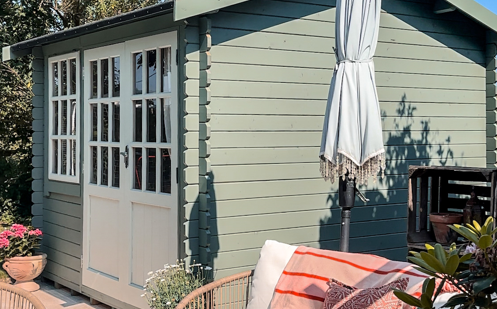
•    Paint it mint green and sky blue, then, add some classic wicker furniture for the ultimate retreat at the end of your garden.

•    Give it a homely feel with cushions in retro floral prints and a pretty painting.

•    Add a rug for extra comfort, and hang a voile curtain across the door so you can shelter from the sun but still enjoy the breeze.

•    Put up a shelf to store all your favourite books, along with some lanterns for evening reading.


These changes in style seem far from the previous ideas and uses for a shed described by Gareth Jones in his 2004 book, ‘Shed Men.’ Contrastingly from Shed Chic, Shed Men “examines the quirky phenomenon of sheds and sheddism, arguing that a bloke's shed begins where a boy's room leaves off, providing a home to the prized objects and boyish dreams there is seldom room for inside the house.” How times have changed.


          However, to all men who are mourning the loss of their trusty haven, you should take a moment to consider those less fortunate than yourselves. While the western world has until now regarded the garden shed as a primarily male dominated environment, in other cultures it would seem that this sacred right of men has always been absent. In India for example, you may stumble across a rather more alternative (if not a little disturbing) use of the garden shed.


          Buried in the Pudukottai region of India is a village named Narikudi, consisting of no more than 102 families. Here in this remote community you will encounter a collection of sheds, constructed entirely with one purpose in mind; to accommodate the women. So how did they get so lucky? Well, hold on a second. It seems these carefully constructed allotments exist solely to house women of the village during a ‘particular few’ days of the month. Now, whilst at first this may seem reasonable, upon further thought, using a shed to shut a woman away for five days may be extending its versatility a little too far. However in this same village it would not be considered unusual for a woman to go through all the traumas of labour with nothing but the humble comforts of these rudimentary shacks. Nonetheless, this tradition, locally known as Poyyalamman, is a highly cherished and respected part of life; here the women voluntarily enter into this form of confinement with the firm beliefs that they are partaking in a prestigious ritual. According to Mamanga, a mother of seven children, “… Poyyalamman protects us all”. It would seem that here, the infiltration of women into the world of the garden shed has been taken to an entirely different level.


Sheila Sheds


          Similarly, deep down under on the Australian coast, an equally alarming concept had been born: the Sheila Shed. These sheds are designed specifically for the past times and delights of women. In the town of Kempsey ‘sheilas’ congregate regularly in large sheds to teach each other the best ways one can create a chopping board, or a bread bin, with the assistance power tools. The idea was born to create a women’s equivalent of the “Men Shed” society which had previously existed in Kempsey in isolation: according to Jocelyn Strutt there were some women who felt they had "… been there done that with the knitting, crocheting and patch working skills and just want[ed] to do something different."


          While this way of life is unlikely to catch on everywhere, it’s clear that a definite shift in the world of the garden shed has taken place. The media has introduced home improvement as an activity for both sexes and that, along with an economic downturn, has encouraged a change in attitude toward that little bit of extra space sitting at the bottom of the garden. Jan Heffernan of Kempsey, Australia sums it up, “I go to shops and look at power tools now instead of knitting needles."

Post info

Categories: gardening , sheds